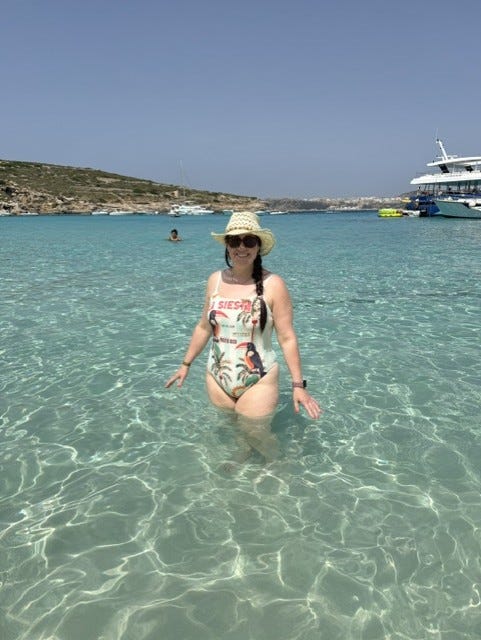
Take Action Doesn't Mean Do More.
Sometimes the most powerful action you can take is getting into cold water and remembering you have a body.

It is Mental Health Awareness Week, and this year’s theme is Take Action.
When I first heard that phrase, I felt the familiar pull of the to-do list brain. Take action. Do something. Fix something. Move faster, push harder, be more.
But I have been a Psychotherapist for long enough to know that this is exactly the kind of thinking that lands many of my clients in my therapy room in the first place. The idea that action means more. That doing counts as being. That if we are not producing, striving, optimising we are somehow falling behind.
So I want to offer a different interpretation of taking action this Mental Health Awareness Week. One that I have learned not just as a therapist, but as a woman who stands in cold rivers on purpose!
Sometimes the most radical action you can take is to slow down. To step outside. To get in the water. To give your nervous system what it has been quietly begging for.
Sometimes the most radical action you can take is to slow down. To step outside. To get in the water.
A Little Bit About Where I’m Coming From
I am a Psychotherapist specialising in women’s health and chronic pain. I also happen to be a mum of two, a vanlife convert, and the person who will now always be the one suggesting we find a river to get into.
My Instagram account, Dipping for Joy, started as a record of my wild swimming, just a place to share the journey and connect with like minded women. It has become something else, a place I found community of women finding their way back to themselves through nature, cold water, and the particular kind of honesty that only seems to happen when you are standing waist-deep in a Scottish loch wondering what you were worried about.
The two things, my clinical work and my time in the water are not separate. They have never been separate. The science of why cold water swimming helps us is the same science I work with every day in my therapy room. And I think more people deserve to understand it.
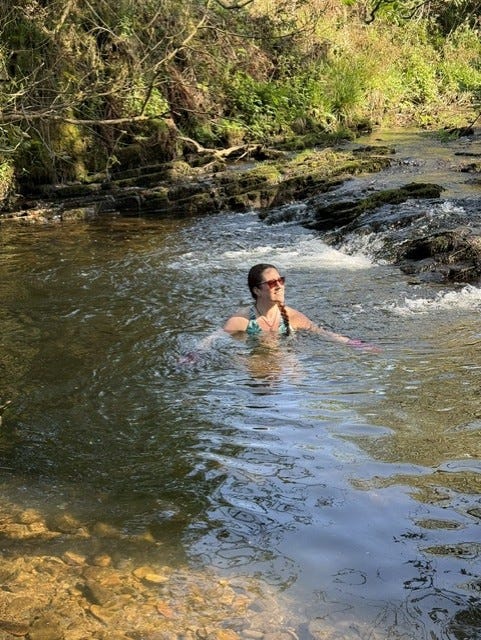
Your Nervous System Is Not the Enemy
Many of the women I work with come to me exhausted. Not just tired, but that deep, cellular exhaustion that comes from a nervous system that has been in high alert for so long it has forgotten what calm feels like.
Chronic stress, chronic pain, anxiety, burnout, the relentless mental load of motherhood- all of these keep our nervous systems stuck in a state of activation. Our bodies are primed for threat even when the threat is simply the school run or an overflowing inbox.
This is not weakness. This is biology doing exactly what it was designed to do. The problem is that modern life does not give us many opportunities to complete the stress cycle, to signal to our nervous systems that the threat has passed and it is safe to rest.
Cold water is one of the fastest and most effective ways to do exactly that.
🔬 The Science: What Cold Water Does to Your Nervous System
When you enter cold water, your body triggers an immediate stress response, heart rate spikes, breathing quickens, adrenaline surges. But something remarkable happens when you stay in and breathe through it. The parasympathetic nervous system- your rest and digest state begins to take over. Cortisol drops. Dopamine flood the system. The body learns, in real time, that it can move through discomfort and come out the other side. This is regulation. And with regular practice, this capacity begins to carry over into daily life.
The Vagus Nerve -Your Body’s Reset Button
If you have spent any time in wellness spaces recently, you will have heard about the vagus nerve. There is good reason for that. The vagus nerve is the longest cranial nerve in the body, running from the brainstem all the way down through the heart, lungs and digestive system. It is the primary pathway of the parasympathetic nervous system the part responsible for rest, repair and recovery.
Vagal tone is the health and responsiveness of this nerve. It is directly linked to our capacity to regulate emotion, manage stress, recover from illness, and connect with other people. Low vagal tone is associated with anxiety, depression, inflammatory conditions and chronic pain. High vagal tone is associated with resilience, emotional regulation, and physical wellbeing.
Here is where cold water becomes genuinely remarkable.
🔬 Cold Water and Vagus Nerve Stimulation
Cold water immersion particularly around the face, neck and chest directly stimulates the vagus nerve through a mechanism called the diving reflex. This reflex slows the heart rate, redistributes blood flow to vital organs, and activates the parasympathetic nervous system. Regular cold water exposure has been shown to improve vagal tone over time, meaning the more you practice, the more regulated your nervous system becomes, not just in the water, but in your life.
As a Psychotherapist working with women in chronic stress and overwhelm, I cannot overstate what this means. We spend enormous amounts of time and energy in therapy learning to regulate the nervous system through breathing, through body awareness, and through working with the window of tolerance. Cold water can be a powerful, accessible, embodied way to practice exactly this. Not instead of therapy. Alongside it.
The more you practice, the more regulated your nervous system becomes - not just in the water, but in your life.
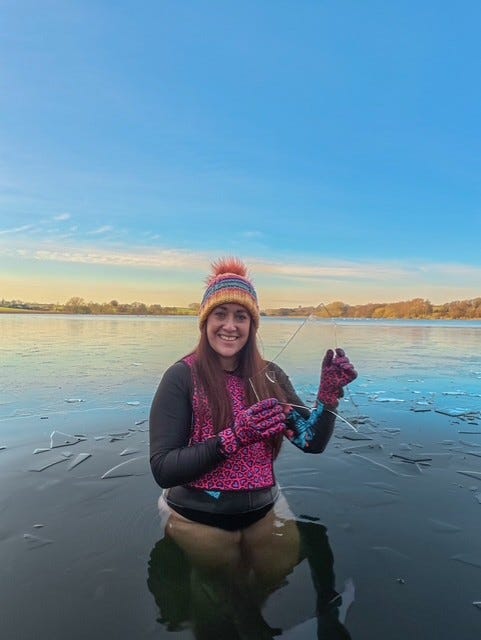
Cold Water, Chronic Pain and Women’s Health
Much of my clinical work is centred on women living with chronic pain - fibromyalgia, endometriosis, hyper mobility, long covid, autoimmune conditions, and the complex intersection of hormonal health and pain that is so frequently dismissed or under treated in women’s healthcare. (On a side note I also have Subtack for this, feel free to have a nosey: Pain Therapist Subtack)
Chronic pain is not simply a physical experience. It is a whole-system experience shaped by the nervous system, by inflammation, by sleep, by stress, and by the stories we carry about our bodies and what they can and cannot do.
Cold water does not cure chronic pain. I want to be honest about that. But what I have seen in my own body on harder days is that it can interrupt the pain-stress cycle in ways that are genuinely meaningful.
How cold water can support women living with chronic pain:
Anti-inflammatory effect: Cold water immersion reduces systemic inflammation markers, which play a significant role in many chronic pain conditions
Endorphin release: The cold triggers a natural release of endorphins- the body’s own pain-modulating chemicals
Nervous system regulation: By activating the parasympathetic response, cold water helps move the body out of the pain-amplifying effects of chronic stress
Improved sleep: Regular cold water exposure has been linked to deeper, more restorative sleep - and poor sleep is one of the most significant drivers of pain amplification
Embodiment and agency: For many women with chronic pain, the experience of choosing to do something challenging with their body - and succeeding - is profoundly therapeutic
That last point matters enormously to me as a Therapist. Chronic pain so often creates a sense of betrayal, a body that feels unreliable, unpredictable, out of control. Getting into cold water and coming out the other side is a small but powerful act of reclaiming agency. Of saying: I can do hard things. My body is capable. I am still here.
A Note on Neurodivergent Brains and Cold Water
Something I have noticed in my practice, in my family, and in the wider wild swimming community, is that neurodivergent women in particular often find something uniquely powerful in cold water.
For those with ADHD, autism, sensory processing differences or anxiety-driven nervous systems, the world can feel like constant overstimulation. The noise, the demands, the social navigation, the relentless need to mask and manage and meet expectations.
Cold water cuts through all of it.
There is something about the immediacy of cold water - the way it demands your entire attention in that first moment of entry - that quiets everything else. It is impossible to be in your head when you are in cold water. Your body becomes the only thing that exists. For a neurodivergent brain that rarely gets to simply be present, this can feel like extraordinary relief.
🔬 Cold Water and the Neurodivergent Nervous System
Research suggests that cold water immersion may be particularly beneficial for ADHD brains due to its effect on dopamine and norepinephrine- the same neurotransmitters targeted by ADHD medication. The intense sensory input of cold water can also provide the kind of proprioceptive and interoceptive feedback that helps regulate sensory processing differences. For many neurodivergent women, the wild swimming community has also become a rare space of genuine belonging, where stimming is reframed as joy, and there is no expectation to be anything other than exactly who you are.
I am not suggesting cold water swimming as a replacement for any treatment or support. But I am saying that for many of the women I work with and for myself, getting into a river has offered something that is difficult to find elsewhere. Presence. Simplicity. A body that is entirely, undeniably, gloriously alive.
It is impossible to be in your head when you are in cold water. Your body becomes the only thing that exists.

So What Does ‘Take Action’ Actually Look Like?
This Mental Health Awareness Week, I want to gently challenge the idea that taking action for your mental health means adding something to your already full life.
Sometimes it does. Sometimes action looks like finally making that therapy appointment, or telling someone you are struggling, or asking for the support you have been quietly needing for months. These are important and brave actions and they matter.
But sometimes - especially for women who are already carrying a lot - taking action looks like this:
Driving fifteen minutes to find a river and getting in for five minutes
Sitting outside with your morning coffee instead of at your desk
Saying no to one thing this week so you have space to breathe
Letting the cold water do what no amount of thinking can do
Choosing nature over productivity, just once, and seeing what happens
Taking action for your mental health does not have to be dramatic or expensive or time-consuming. It can be as simple as opening a van door in Scotland and jumping in a loch while your kids scream in excitement and your dog launches himself in without hesitation.
It can be standing in cold water for three minutes and remembering that you are a body in a world, not just a mind with a to-do list.
It can be dipping for joy.
Taking action for your mental health can be as simple as opening a van door and getting in the water.

If You Have Never Tried Wild Swimming
You do not need to start with a Scottish loch in February. Here is how I would suggest beginning:
Starting out safely:
Begin with cooler showers or a cold finish to your normal shower, this begins to train the vagal response gently
Find a managed wild swimming site - places like Whitmore Lakes, Pool Bridge Farm or your local lido are a brilliant first step with safe, supervised entry
Go with a friend- the social element is genuinely important for both safety and the added nervous system benefit of co-regulation
Start short- even two minutes has meaningful physiological benefit. You do not need to stay in long
Focus on your breath- slow your exhale as you enter. This is you actively stimulating the vagus nerve in real time
Notice what happens after- most people describe a profound sense of calm, clarity and even euphoria in the hour following a cold dip
This Week, Take the Action That Your Nervous System Actually Needs
If you are a woman carrying more than your share and statistically, you probably are- I want you to consider that the most important action you can take this Mental Health Awareness Week might not be on your to-do list at all.
It might be outside. It might be in the water. It might be in the quiet moment when you let nature hold you for a little while and remember that you are allowed to take up space and slow down and feel things.
Your nervous system is not broken. It is exhausted. And it knows, on some level, exactly what it needs.
Sometimes you just need to give it the chance to find out.
If you are living with chronic pain, a neurodivergent nervous system, or complex mental health needs, please speak with your GP or a qualified health professional before beginning cold water swimming. Everything I have written here comes from both clinical psychotherapy knowledge and personal experience, but it is not a substitute for individual professional support.
I work as a Psychotherapist specialising in women’s health and chronic pain. If you are looking for support, you can find out more about working with me have a look at My website.
And if you want to see what Dipping for Joy looks like in real life- the cold loch swims, the family vanlife adventures, and the occasional frozen expression - come and find me on Instagram @dipping_for_joy 🌊